

CHAPTER 24
The View from the Kitchen
17 minute read
The walnut tree had dropped its leaves early that year, in the first week of November, as though it had consulted some calendar Stefan could not read and decided the season was finished. He stood at the kitchen window and watched the last of them detach: not falling but releasing, each leaf letting go of its branch with the quiet certainty of something that had held on long enough and knew it.
The coffee was ready. He poured two cups, the way he had poured two cups every morning for thirty-five years in this kitchen, the way he had poured two cups for twenty years before that in Arlington. He had been making coffee for Mila for more than half a century.
He knew the cup she preferred. The blue one with the chipped rim, bought at the market in Sarlat in their third year. Mila had picked it up and turned it in her hands and said, "This one." She had not said why. The chip had happened later, in a way neither of them could remember, which meant it had happened in the way most things in a long life happen: without announcement, between other moments, becoming part of the object so gradually that the damage and the beauty were no longer distinguishable.
He set her cup on the table. Black, no sugar. His own with milk, a habit he had carried from Pretoria and never shed, despite decades of French friends who regarded milk in coffee the way one might regard socks with sandals: not a moral failing, exactly, but a failure of seriousness.
The kitchen was warm. The orange tiles were long gone. In their place, Stefan had laid limestone slabs he and Jean-Pierre had cut from a quarry remnant the old mason had sourced from a farm near Domme. Stefan had wanted to plan it on a grid. Jean-Pierre had looked at the grid, looked at Stefan, picked up a slab, and placed it by eye. The floor was not perfectly level. It was perfectly right.
Stefan's hands, holding the coffee, were the hands of an old man. He noticed this sometimes with a mild surprise, the way you notice a change in a room you have lived in so long that you no longer see it. The knuckles were thicker. The skin was spotted with the brown marks the sun leaves on fair skin over decades of garden work. His fingers still worked, still turned the soil and pulled the weeds and tied the tomato vines to their stakes, but they were slower now, and they ached in the mornings until the coffee warmed them.
He was eighty-five. The number did not alarm him. Numbers had never alarmed Stefan. They were data points, and data points were neutral. Eighty-five meant his knees complained on the stairs and he could no longer read the small print on the walnut oil bottles without the glasses that were always on the wrong table. It also meant he had been alive for eighty-five years, which seemed, on balance, a reasonable return on the investment.
Mila came into the kitchen. She wore the grey cardigan she had owned for fifteen years and a scarf, deep blue, knotted at her throat the way she had knotted scarves since Cape Town. Her hair was white now, all of it, worn short. Her hands were paint-stained. They were always paint-stained. The cadmium yellow in the creases of her knuckles had been there so long it might have been a feature of her skin, like a birthmark or a scar.
She picked up her cup. She looked out the window.
"The walnut tree," she said.
"Bare," he said.
"Not bare. Resting."
He looked at the tree. Bare seemed accurate. But Mila saw things differently. She always had. She looked at a bare tree and saw a tree holding its shape through winter, carrying the memory of its leaves in the architecture of its branches, waiting for the spring it knew would come.
"Resting," he agreed.
The drive to Sarlat took twenty minutes. Stefan drove. Mila sat beside him and did not comment on his driving, which was itself a comment. She had suggested, twice in the past year, that perhaps they might arrange for deliveries. Stefan had considered this the way he considered all suggestions that implied limitation: carefully, respectfully, and then he had picked up the car keys.
The market was smaller in November. The summer vendors were gone. What remained was the core: the cheese, the bread, the vegetables, the walnut oil. The woman who had sold them their first bottle of oil was retired now, or dead, Stefan was not sure which, but her stall was still there, run by a younger woman with the same brown hands and the same way of uncorking a bottle and tipping a thread of oil onto bread without looking.
He bought oil. He bought cabecou wrapped in a chestnut leaf. He bought bread at the boulangerie, the crust dark and still warm when the woman handed it to him in a paper bag.
He had stopped keeping the spreadsheet years ago. The columns and rows that had organized his first tentative purchases in 2019 had served their purpose, which was not, he understood now, to catalogue the market but to give himself permission to be in it. The spreadsheet had been a frame. Inside the frame, he had learned to see. And then the frame had become unnecessary, the way scaffolding becomes unnecessary when the wall can stand on its own.
He knew the vendors by name. They knew him. Not as a foreigner, not anymore. As Stefan.
Mila waited by the car. She leaned against the Peugeot and watched the town and the pigeons on the cathedral roof, and she composed, because she was always composing. Stefan returned with the bags. Mila reached over and broke a piece from the end of the bread, the way she had broken bread in the car every Saturday for three decades, scattering crumbs that Stefan would vacuum on Tuesday, because the crumbs were part of the system now.
The garden in November was a study in subtraction. The tomatoes were finished, the runner beans pulled, the courgettes done. What remained was the structure: the raised beds, the gravel paths, the cold frames where winter lettuces showed their first true leaves, pale green against dark soil.
He worked in the garden every morning from nine to eleven. His body set the schedule now, not his ambition. After that he sat on the bench he had made from the hull of the boat, the little sailboat they had bought in 2021 and sailed for fifteen years. The seat curved slightly, following the original shape, so that sitting on it was like sitting in the boat, except the garden did not move and the only waves were the wind through the lettuces.
On the kitchen wall, above the table, a framed nautical chart of the Arcachon basin hung between a painting of the walnut tree and their wedding photograph from Franschhoek, faded now, the color shifting toward blue. In the upper right quadrant, where the basin opened to the Atlantic, Stefan had drawn a line in pencil. The route of the storm. October 2030. A squall that had come in from the west without the courtesy of a forecast.
They had sailed through it. Not heroically, but with the focused, wordless cooperation of two people who had been working together long enough that the work did not require discussion. Stefan on the tiller. Mila on the sheets. And then the harbor, the mooring lines made fast, the two of them sitting in the cockpit with the rain still falling and their hands shaking and the enormous, stupid grin they had shared, the grin of people who had been frightened and were now safe.
Sometimes Stefan traced the pencil line with his finger and smiled. Not at the danger but at the partnership.
Jean-Pierre had died in the spring of 2049. He was ninety-seven, or ninety-eight, depending on which document you consulted, because the registrar in Carsac had recorded the date a week late, and Jean-Pierre had never corrected it because, he said, a week was nothing to a stone.
He had died the way he had lived: without fuss, in his own house, with a glass of Bergerac on the nightstand that he had not finished. His nephew, who had inherited the vineyard and who made wine that was not quite as good as his uncle's but was getting better, found him in the morning.
Stefan built the wall around his grave marker. Three days. He selected the stones from the same quarry remnant Jean-Pierre had shown him thirty years before, choosing each one the way Jean-Pierre had taught him: by weight, by grain, by the way the stone sat in the hand. He laid the base course dry-stacked, each stone finding its seat through gravity and geometry. The upper courses he mortared, because Jean-Pierre understood that tradition without function was vanity.
Stefan had not spoken at the funeral. His French, after thirty years, was sufficient for argument and affection, but not for grief, which requires either your first language or no language at all. He stood beside the grave and said nothing and built the wall and that was enough. A good wall said everything a eulogy could not.
Mila painted in the mornings. The canvases were smaller now. Not because her ambition had contracted but because her arms tired sooner, and a smaller canvas meant she could finish in a morning rather than across three. The brushstrokes were looser, too. She painted the way old pianists play: with less force and more meaning, every gesture carrying the weight of all the gestures that had come before it.
The studio windowsill was empty. Cezanne had died in 2048, curled on the foot of their bed, which was where she had always slept, unlike Minou, who had claimed the windowsill and held it with the sovereignty of a minor aristocrat. They had buried her next to Minou, under the walnut tree, where Stefan had laid a flat stone and Mila had painted both their names in cadmium yellow: MINOU. CEZANNE. The paint was fading now, but slowly, the way everything in this climate faded: with dignity, over years, the color softening rather than vanishing.
They had not gotten a third cat. The decision was not discussed. It was understood, the way many things between them were understood, in the silence that was not absence but agreement. The house was quieter. The windowsill caught the morning light and held it without a body to warm, and Mila sometimes looked at the empty sill and then looked away and then looked back, and the looking was its own small grief, renewed daily, a grief she did not wish to resolve because the grief was also a form of remembering.
She was painting the view from the kitchen window. She had been painting this view for thirty-four years. The walnut tree, the stone wall, the valley descending toward the river that was invisible but implied by the shape of the land. She had painted it in spring, when the tree was a cloud of pale green. In summer, when the canopy was so dense the valley was a suggestion rather than a fact. In rain, the stone wall dark with water, the sky and the land merging into a hundred colours pressed so close they appeared uniform. In snow, twice, because snow in the Dordogne was rare enough to be an event and an event demanded a canvas.
Each painting was different because the light was never the same twice. This was the thing she had understood since Cape Town, since the first painting of Table Mountain in February light. Light was not a condition. Light was a subject. And the view from the kitchen window was the subject she had been given, or had chosen, or had arrived at through the long accumulation of choices and accidents and wrong turns that had brought her from Lyon to Cape Town to Virginia to this farmhouse, this kitchen, this window, this tree.
The painting on the easel was small, perhaps thirty centimeters square. November light. The walnut tree bare, its branches dark against a sky the color of pewter softened by distance. The stone wall in the middle ground, Stefan's work and Jean-Pierre's indistinguishable, the old stones and the new ones weathering into the same warm gold-grey. The brushstrokes were loose. Not careless. Knowing. Less paint, more light. Less detail, more truth. The painting was not finished. She was working on the sky, the particular quality of November light in the Dordogne, which was not the dramatic light of Cape Town or the flat light of Virginia but something older, something that fell on the stone and the canvas with the tenderness of long acquaintance.
Their evenings were simple. Dinner from what they had grown and bought: the bread, the cheese, the salad from the cold frame, the walnut oil drizzled over everything, the wine from Jean-Pierre's nephew. They ate at the kitchen table, the window behind Mila dark, the walnut tree a silhouette against the last light. They talked in a language that was neither English nor French but something they had built between them over fifty years, a private dialect in which the grammar was English and the endearments were French and the laughter was in no language at all. No one else could follow it. They did not need anyone else to follow it.
After dinner, if the evening was mild, they walked down the lane to the stone pillar at the edge of the road, the one that had said LACOSTE when they arrived and now said VAN DEN BERG-FOURNIER. Their footsteps were slower than they had been. The walk that had once taken five minutes now took ten. They did not mind. The evening light was patient.
Sometimes Stefan took Mila's hand. Sometimes she took his. The reaching was automatic, the fingers finding each other with the precision of long practice, the way they had found each other in the dark of the farmhouse on their first night, the way they had found each other across the table in Camps Bay when they were young and did not yet know what they were beginning.
They walked back. They read, or Mila sketched while Stefan read, the fire burning low, the embers orange. The house held them the way it had always held them: in stone, in warmth, in the accumulated silence of thirty-five years. The house was not a thing they lived in. It was a thing they had made. And the making had been the living.
They went to bed. The iron bed the previous owners had left, the one that had creaked on the first night when the cold was geological and the owls called from the walnut tree. It still creaked. They did not notice.
Stefan died on a Tuesday in late November. In his sleep. In their bed.
Mila woke and knew before she reached for him, the way you know the weather has changed before you open the curtain. His body was still. Not the stillness of sleep, which has its own small movements, its own tides of breath and settling. A different stillness. The stillness of a house after the fire has gone out.
She did not call anyone. She lay beside him for a long time. The light through the south-facing window was thin November light, the kind that enters a room not to illuminate but to accompany. She held his hand. His fingers were cool and still and she held them the way she had always held them: without searching, without fumbling, the distance between their hands so long memorized that even now, even this, was a gesture of familiarity rather than grief.
She looked at the window. The valley was there, muted. The walnut tree bare. The stone wall. The garden, the bench made from the hull of the boat. All of it visible, all of it still there, all of it exactly as it had been yesterday and would be tomorrow and was, right now, in this light, the view from the window of a room where a man had died peacefully in his sleep beside the woman he had loved for sixty years.
She sat with him until the light changed. Then she called the doctor.
Mila died three months later. February. In her sleep, in the same bed, on a night when the temperature dropped below freezing and the stone walls held the cold the way they had held the cold on the first night, the night they had arrived with four blankets and two airline blankets and no certainty about anything except each other.
The neighbors found her. The doctor, the nephew, the woman from the boulangerie who had noticed the bread had not been collected on Saturday. They came to the farmhouse and found the door unlocked, because it was always unlocked, because a locked door was a door that did not trust the place it stood in, and they had trusted this place with everything.
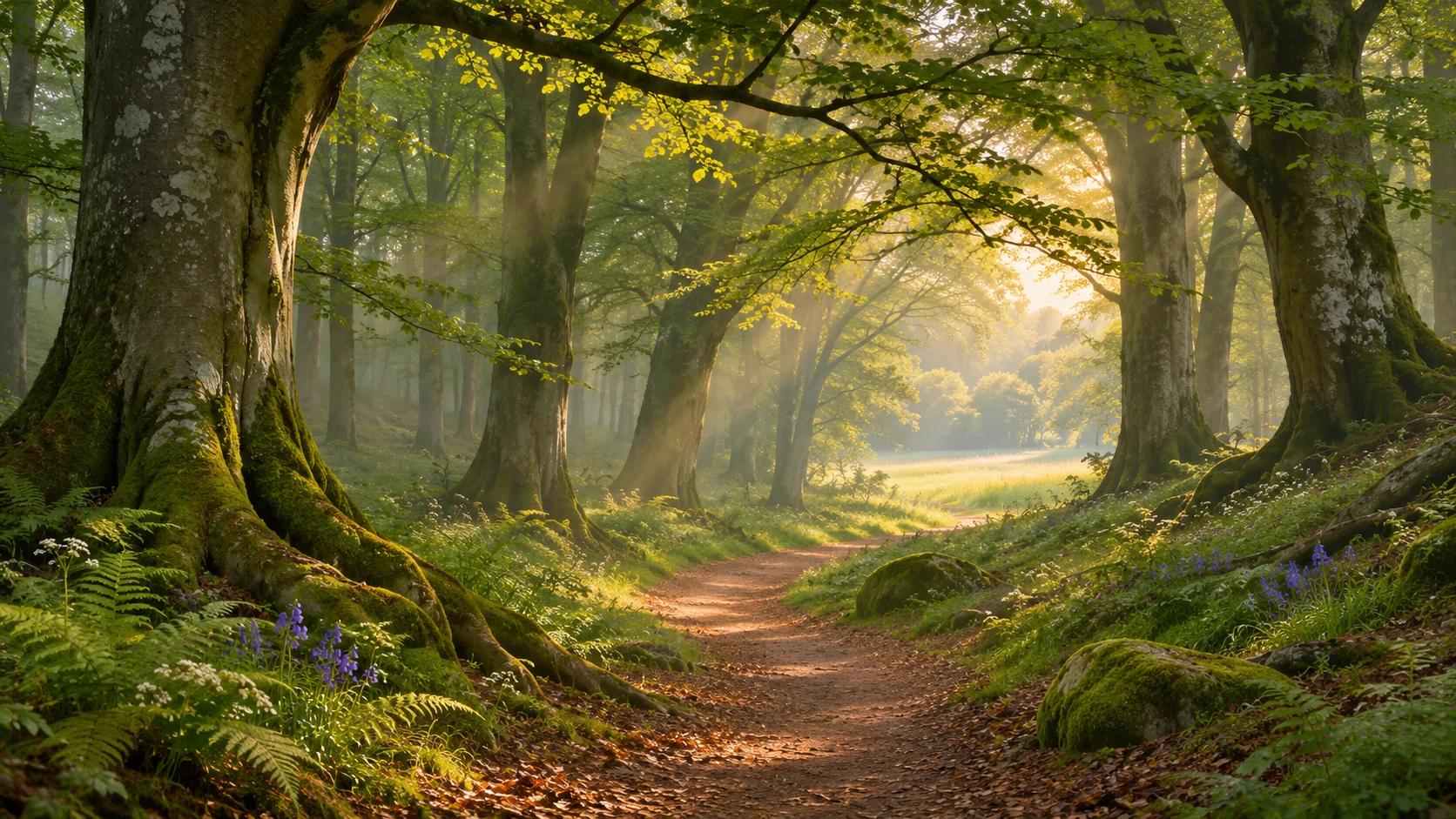
The farmhouse stands in the light. The light in the Dordogne is old, and it falls on the stone and the glass and the bare branches of the walnut tree with the patience of something that has been doing this for longer than the house has stood, longer than the walnut tree has grown, longer than anyone has been alive to call it beautiful.
The studio windows face north. The light comes through them in long, cool rectangles that fall across the paint-stained floor, the shelves of canvases, the empty windowsill where two cats, one after the other, watched the valley for a combined twenty-nine years. The easel stands near the window. On it, a canvas, thirty centimeters square. The view from the kitchen window: the walnut tree, the stone wall, the valley. November light. The brushstrokes trail off in the upper right corner, where the sky meets the ridge, as if the painter had been working and then paused, and turned to look at the real thing instead of the painting of it, and had not turned back.
The kitchen is clean. The blue cup with the chipped rim sits on the shelf. The walnut oil is on the counter, the bottle half full, the label handwritten. The nautical chart of the Arcachon basin hangs on the wall, the pencil line still visible, the route of the storm, the route home.
The garden is beginning to change. Not yet wild. The raised beds still hold their shape, the cold frame still shelters the winter lettuces, which are growing without anyone to harvest them. But the edges are softening. The brambles will return to the south wall, slowly, the way brambles return, with patience and thorns. The garden will become what gardens become when the people who tended them are gone: not ruined but released, the structure dissolving into a green that is its own kind of order, the order of things that grow because growing is what they do.
The bench made from the hull of the boat sits in the garden, facing the valley. It is empty. It will weather. The wood is good.
The walnut tree stands at the center, bare and enormous and patient, its branches holding the shape of the canopy that will return in April. Beneath the tree, two flat stones mark the place where two cats are buried, the painted names fading to gold.
The stone wall runs along the garden's edge. Stefan's work and Jean-Pierre's, indistinguishable now, the mortar joints tight, the courses level. The wall will stand. That is what good stonework does. It stands.
The house is quiet. But the quiet is not empty. The walls hold the warmth of thirty-five winters of fires. The kitchen holds the smell of bread and walnut oil and coffee. The studio holds the light that Mila followed from Lyon to Cape Town to Virginia to this window, this view, this valley, this home. The bedroom holds the impression of two bodies that slept beside each other for so long that the mattress remembers their shapes, the way the garden remembers the rows, the way the stone remembers the hands that laid it.
All of it is still here. The walls, the garden, the paintings, the meals, the years. The view from the kitchen window: the walnut tree, the stone wall, the valley. The same view. Different light. Always different light.
The house holds what they made. It holds what they were. Not in memory, which fades, but in the stone, which does not. In the garden, which will grow. In the paintings, stacked and lit by the north-facing windows. In the cup on the shelf and the oil on the counter and the pencil line on the chart and the bench in the garden and the wall along the edge and the tree at the center and the light, the light, the light that falls through the windows of an empty house and finds, in every room, the evidence of two people who were here, who built this, who made this, who lived.