
CHAPTER 03
The Geometry of Desire
13 minute read
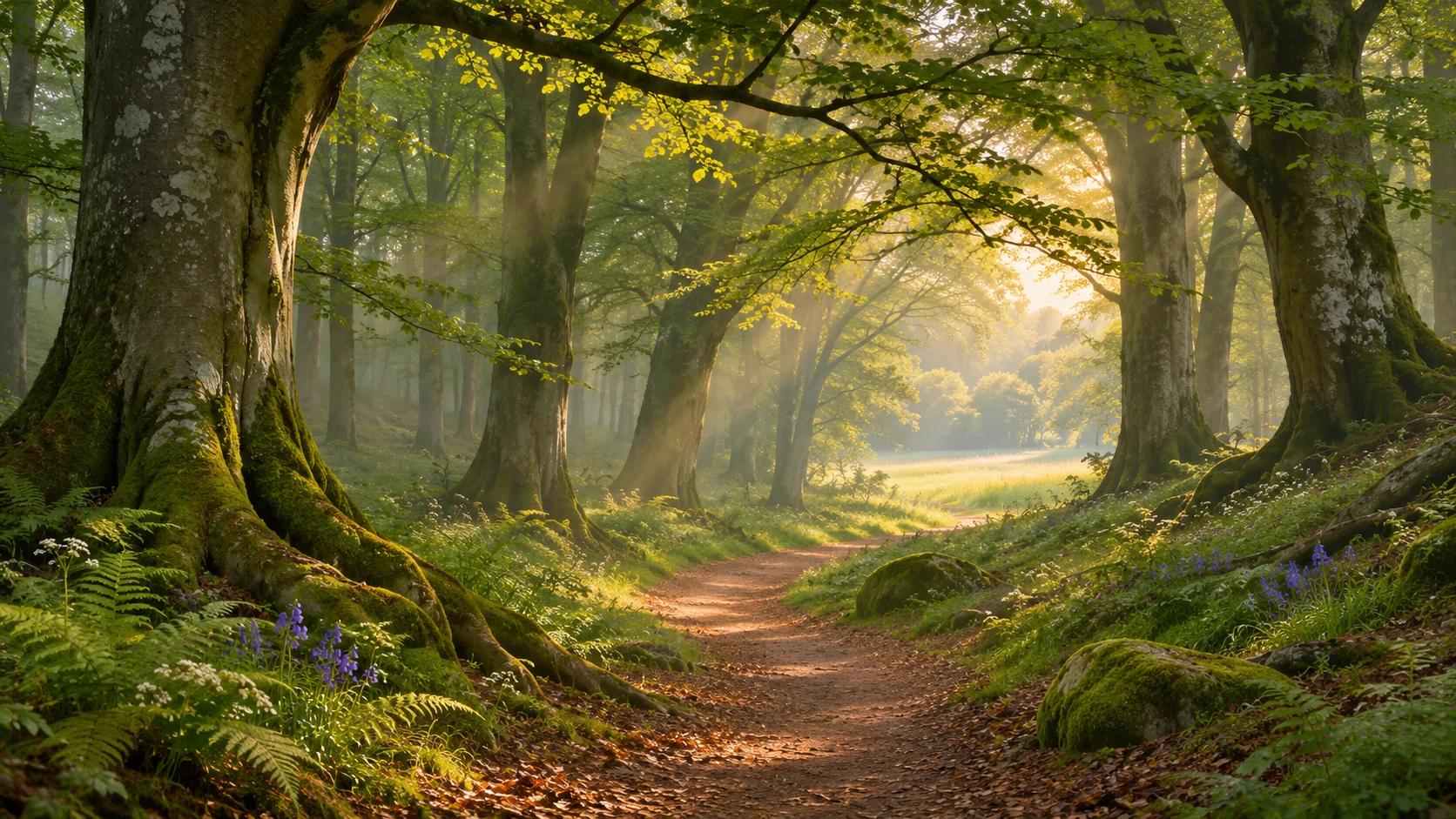
The trail up Lion's Head began in darkness. Stefan had suggested four-thirty, which Mila had called barbaric, which had led to a negotiation that ended at five, which meant they started climbing at five-twenty because she could not find her left shoe. He did not yet know this about her. He would learn.
The path was rocky and steep and they climbed in the light of a headlamp Stefan had bought the day before. He had also packed water, plasters, and a compass, though the trail was marked and they could not possibly get lost. Mila carried nothing. She wore canvas shoes that were not hiking shoes and a cotton dress that was not hiking clothes and she climbed faster than he did.
"You're going to twist your ankle," he said.
"Then you'll carry me down."
"I won't."
"Then I won't twist my ankle."
He tried to formulate a rebuttal about probability and terrain, but she had already rounded the next switchback and her laughter floated down to him, disembodied in the dark.
They reached the saddle as the sky began to change. Not sunrise yet. The suggestion of it. The city below was still lit, a scattered constellation pressed between the mountain and the sea. To the west, the Atlantic. To the east, False Bay. Cape Town lay between them like a narrow truth.
"There," Mila said.
She was pointing at nothing he could identify. The harbor, perhaps. The dark mass of Robben Island, where Mandela had spent twenty-seven years and from which he had walked free only months ago. Or maybe she was pointing at the light itself, the first pale band of gold along the horizon.
"What am I looking at?"
"Everything. All of it. That is what you are looking at."
Stefan sat on a flat rock. Mila sat beside him. Their shoulders touched. The contact was new enough that he noticed it, the warmth of her through two layers of cotton, the slight lean of her weight against him.
"In Pretoria," he said, "the ridges close around you on every side. There is no distance. You always feel enclosed."
"And here?"
"Here everything opens."
She turned to look at him. In the gray light her eyes were very dark. "Is that why you came?"
"I came for the computer science program."
"That is the reason you would write on a form. I am asking for the real one."
He thought about it. Below them, a car's headlights traced the road along Signal Hill. Somewhere a muezzin began the call to prayer, faint and extraordinary, threading through the air from the Bo-Kaap. The sound reached them as a kind of filament, impossibly thin, impossibly strong.
"I wanted to be somewhere that was becoming something," he said. "Pretoria felt like it was holding its breath. Cape Town felt like it had already started breathing."
"That is a good answer."
"Is it the right one?"
"Answers are not right or wrong, Stefan. They are honest or they are not."
This was how she spoke. Declarative, certain, as though she had considered every possible position and arrived at this one through some process he could not access. He would spend months trying to locate the logic behind her convictions. He would never find it. Her certainty came from somewhere he did not have the coordinates for, and this was the thing that pulled him toward her with a force that frightened him.
The sun broke the horizon. The city turned gold.
He took her to dinner three times that week. Each time he arrived early. Each time she arrived late. The third time, at a small restaurant in the Bo-Kaap where the tables were pressed close together and the walls were painted the same vivid blue as the houses outside, she said: "You are always early because you are afraid of being unprepared. I am always late because I am afraid of waiting."
"Those are the same fear."
"They are not. Yours is about control. Mine is about vulnerability."
The waiter brought bobotie in a clay dish, fragrant with turmeric and cinnamon, studded with raisins that had gone soft and sweet in the custard. Stefan had never eaten Cape Malay food before moving to Cape Town. In Pretoria his family had eaten boerewors and potjiekos and his mother's mealie pap. This was a different country. Or perhaps it was the same country and he had simply never been allowed to see it.
"My father would not eat this," he said.
"Why?"
"Because it comes from someone else's kitchen."
Mila understood immediately. She did not ask him to explain further. She heard what was underneath the words. She heard the Afrikaner boy from Pretoria who had grown up in a world of careful separations and who had come to Cape Town partly to escape them and partly because he did not yet have the language for what he was escaping.
"My father would eat anything," she said. "He once ate a live sea urchin because a fisherman in Marseille dared him."
"That is very French."
"That is very my father." She broke a piece of bread and used it to scoop up the bobotie. "He believes that refusing food is refusing life. He says the table is the only honest place in the world. Everyone's mouth is full, so no one can lie."
Stefan laughed. The sound surprised him. He did not laugh easily or often. He smiled readily enough, a contained expression that kept the world at a comfortable distance, but laughter was involuntary. A system failure. A breach in the architecture.
She made him laugh again that night, and again the night after, and he began to understand that she was not breaking his systems. She was revealing that the systems had gaps. They had always had gaps. He had simply been disciplined enough not to look.
October. The jacarandas bloomed in the avenues near campus. Stefan walked through them on his way to the computer lab and thought of Mila, which was new. He did not typically think of people when he was walking. He thought of problems. Sorting algorithms, network topologies, the architecture of databases. His mind was a workshop, not a gallery.
Now it produced her. Her voice saying "That is a good answer." The way she tilted her head when she was about to disagree with him, a small lateral movement, birdlike, as though she needed to see him from a different angle before she could locate the flaw in his argument.
He mentioned this to his roommate, Pieter, a fellow Afrikaner from Stellenbosch who was studying civil engineering.
"You're in trouble," Pieter said.
"I'm not in trouble."
"You just described the angle of a woman's head to me. You're in trouble."
Stefan could not dispute this.
November. The arguments began. Not fights. Arguments. The distinction mattered. A fight was a failure of communication. An argument was communication at its most alive, two systems of thought colliding and producing heat and sometimes light.
They were sitting on the steps of the Hiddingh Hall campus, where the art school held its classes. Mila had paint on her wrists, cadmium yellow and a green she later told him was viridian. She had been working on a series of paintings of Table Mountain at different times of day, trying to capture how the light changed the mountain's apparent shape. She was nineteen. The paintings were uneven. Some of them were extraordinary.
"Beauty is pattern," Stefan said. He was holding a protea, one of the great bristled flowers that grew wild on the slopes above the university. He turned it in his hands, examining it. "Look at this. The spiral arrangement of the petals follows the Fibonacci sequence. The ratio of the flower's diameter to its height approximates the golden ratio. This is not accidental. Beauty is mathematical."
Mila took the protea from him. She held it the way she held everything, with a kind of visual greed, turning it to catch the light.
"The Fibonacci sequence," she said. "You think this is why it is beautiful?"
"I think it is one of the reasons."
"Stefan." She said his name the French way, with the stress on the second syllable, which did something to his chest he could not have diagrammed. "The protea is beautiful because it does not know it is beautiful. A thing that knows it is beautiful becomes something else. It becomes a performance."
"That's not an argument against mathematics. Mathematics doesn't know anything. It simply describes."
"It describes after the fact. The flower does not consult the Fibonacci sequence before it grows. It grows, and then you come along with your numbers and say, look, I have explained it. But you have not explained it. You have measured it."
"What is understanding, then?"
She pressed the protea against her cheek, the rough bristles catching on her skin. "Understanding is when you stop trying to explain and start trying to see."
He had counterpoints, strong ones, about how mathematics was itself a form of seeing, about how the patterns were inherent in the structure. But she was sitting there with a protea pressed to her face and viridian paint on her wrists and the late afternoon light was turning her hair almost auburn and he could not think of a single number.
"You're cheating," he said.
"How am I cheating?"
"You're being beautiful while arguing that beauty can't be analyzed. It's a conflict of interest."
She laughed. The sound of it went through him like a current.
December. The city heated. Students left for the holidays. Stefan stayed, because his consulting work for a small IT firm in Rondebosch did not observe the university calendar and because Mila stayed. She was painting. She painted every day now, sometimes ten or twelve hours, returning to her flat with turpentine in her hair and a kind of radiance that came from having spent the day inside her own ability.
The country was remaking itself around them. On television, the Convention for a Democratic South Africa convened at the World Trade Centre in Kempton Park. White men and Black men sat at the same table. Stefan watched from the common room of his residence hall, surrounded by students who were too young to vote and too old to pretend it didn't matter. Pieter said nothing. A Black student named Thabo, who was in Stefan's algorithms class and who was better at recursion than anyone Stefan had ever met, sat in the front row and wept silently and nobody looked at him and nobody looked away.
Outside, Cape Town continued. The mountain, the sea, the hawkers on Long Street, the fishing boats in Hout Bay. The city was gorgeous and scarred and rearranging itself, and Stefan and Mila moved through it like two people caught in a current larger than their own.
They hiked. Table Mountain, Lion's Head again, the Pipe Track along the Twelve Apostles. They ate. Gatsby sandwiches in Athlone, snoek braai on the beach at Muizenberg, more dinners in the Bo-Kaap where Mila learned the word "smoortjie" and used it incorrectly for a week. They argued. About Mondrian, whom Stefan admired for his grids and Mila dismissed as emotionally bankrupt. About whether a photograph could be art (yes, she said; it depends, he said; on what, she said; on whether it reveals structure, he said; she threw a breadroll at him).
They did not talk about what they were. They did not define it. Stefan, who categorized everything, who could not look at a bookshelf without alphabetizing it in his mind, did not attempt to categorize this. He understood, in some chamber of himself that was older than his education, that the moment he tried to contain it the container would prove too small.
January. 1991. He kissed her on the sea wall at Camps Bay. The sun was going down and the Twelve Apostles were burning orange above them and the Atlantic was doing something with the light that painters had been trying to capture for centuries and never would. He kissed her and she kissed him back and the precision of it surprised him. Not careful. Not tentative. Precise, the way a brushstroke is precise, placed exactly where it needed to be.
After, she pulled back. Not far. An inch. But he felt it.
"What?" he said.
"Nothing."
"That was not nothing."
She looked at the ocean. Her profile against the sunset was a thing he would remember for the rest of his life, and in remembering it he would understand that some images are indeed beyond measurement, that Mila had been right all along, and that being right had not protected her from anything.
"I am afraid," she said, "that I am not enough of myself yet to give any of myself away."
He did not understand. He was twenty-two and in love and he did not understand that desire and readiness are not the same thing, that you can want a life you are not yet built to hold.
"I'm not asking you to give anything away," he said.
"You are. You don't know it, but you are. That is how love works. It asks for things you haven't agreed to give."
He reached for her hand. She let him take it. Her fingers were cold from the sea wind and he held them and they sat there while the sun dropped into the Atlantic and the sky went from gold to copper to the deep bruised violet that Cape Town does better than anywhere on earth.
"Then I'll wait," he said.
She squeezed his hand. But she did not say "yes, wait." She did not say "I'll be ready soon." She held his hand and watched the water and inside her something was already pulling back, a tide reversing, and he could not see it because he was looking at the sunset and not at her.
February came. The heat was enormous. Stefan finished his thesis. In three months he would graduate top of his class and accept a position in Virginia and fly away from this city and this woman, and he did not know this yet, and she did not know it yet, and the not-knowing was its own kind of tenderness, the last tenderness before the knowing came.
They walked home through the Bo-Kaap that night, past the painted houses, pink and green and cobalt and saffron, colors that made no sense individually and together made perfect sense, like an argument between two people who could not stop reaching for each other. Mila stopped in front of a house the color of turmeric. She stood there looking at it.
"What?" Stefan asked.
"I am trying to memorize the color."
"It's yellow."
"It is not yellow. Yellow is a word. This is a thing." She pressed her palm flat against the wall. "Feel it."
He pressed his hand beside hers. The plaster was warm from the day's sun. Rough under his fingers. He could feel the grain of the sand in the mix, the slight unevenness where the wall had been replastered, the heat stored in the stone behind the surface.
"What am I feeling?"
"Everything. All of it."
She had said this before, on Lion's Head, about seeing. Now she was saying it about touching. He would hear her say it again, across decades, about painting, about cooking, about the view from a kitchen window in a country they had not yet visited. Everything. All of it. This was her answer to every question, and it was the opposite of his answer, which was: this specific thing, this measured quantity, this known variable. Their love was built in the space between these two responses, and the space was wide enough to hold a life and narrow enough that they could always reach across it and find each other's hands.
But that night, walking home, their hands were not quite touching. An inch of warm air between his fingers and hers. He noticed. He did not close the gap. Some part of him, the part that was better at reading systems than he admitted, understood that the gap was not an accident. That she had placed it there. That it meant something he was not yet ready to hear.
The painted houses glowed under the streetlamps. Somewhere above them, the mountain was a black shape against the stars. The city hummed with its own becoming, its slow, painful, extraordinary transformation into something it had never been allowed to be. Stefan and Mila walked through it, together, apart, the geometry of their desire still taking shape, still unsolved, beautiful in the way that only unfinished things can be.